The Phantom Expense: Why the HORECA Industry Should Rethink Inventory Ownership
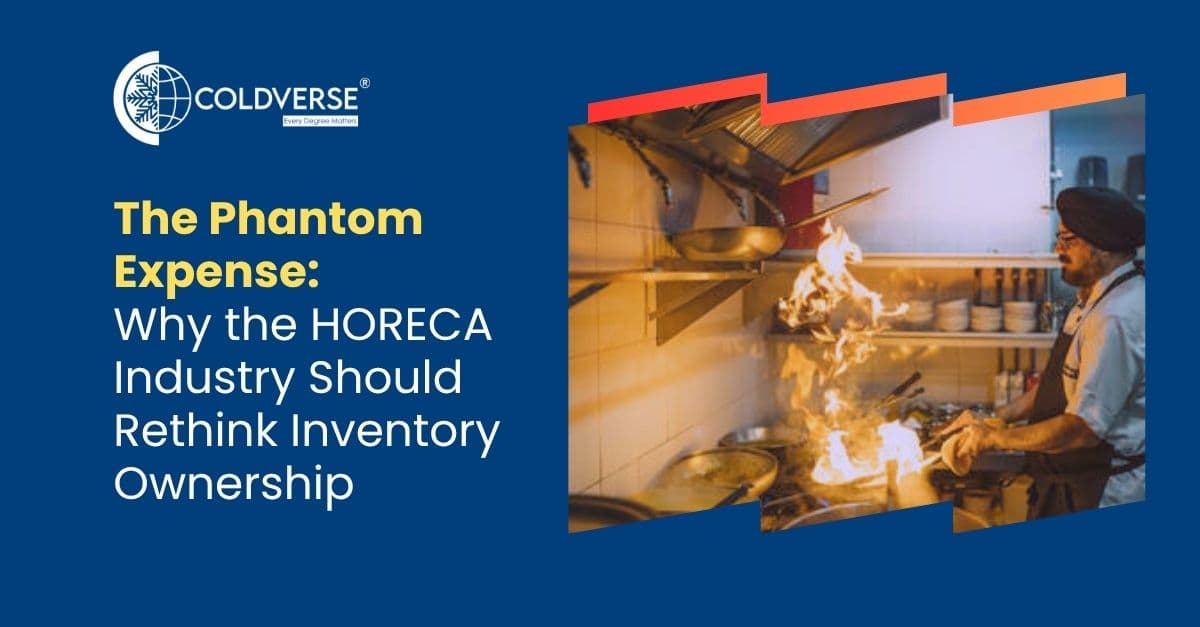
It was 7 pm on a regular Friday evening at The Grand Bistro, the most popular high-end restaurant in Mumbai. The dining room was abuzz with people chattering, laughing, and clinking glasses. However, in the kitchen, things were quite different. Vikas, the Executive Chef, was in a cold sweat. He had just discovered that 3lb of cheese, delivered only yesterday, had spoiled due to a minor fluctuation in the walk-in freezer’s temperature.
Oblivious of the problems, guests enjoyed their appetisers. Vikas wasn’t thinking about plating then, but he was on the phone with three different suppliers, pleading for emergency deliveries. His quick calculation made him realise they had already incurred a loss of ₹ 30,000 that evening.
Is it a failure of culinary skill or a major failure of inventory ownership? For those in the HORECA sector (Hotels, Restaurants, and Catering), this scene is a recurring nightmare. While the industry is built on the art of hospitality, it is held together by the cold, hard science of logistics. Increasingly, the question isn't just how to manage inventory better, but whether hospitality businesses should own it at all.
The Hard Facts: The Weight of the Balance Sheet
In the traditional HORECA model, inventory is viewed as an asset. However, in modern logistics terms, it often behaves more like a liability. Here are the reasons why inventory management is fast becoming a liability.
Food Wastage
A significant portion of food items, especially highly perishable products, is wasted. The reasons are overproduction, spoilage, or overordering. Products like dairy and meat are prone to damage due to shorter shelf lives.
It is not just perishable items that deteriorate due to expiry. Even goods that are not perishable, for instance, dry stock and other amenities, are damaged, broken, or lost due to several reasons in the inventory. There are many problems that an inventory goes through, even while sitting in storage.
Restricted Cash Flow
Investing in inventory is a major cash restriction. Unless it has been used, meaning cooked and sold, the money is not accessible to the business and hence, cannot be used to spend on daily expenses.
Inventory storage takes up space, uses electricity and refrigeration, and takes up time and effort. All of these contribute to expenditure by the business. Inventory management requires expertise that might take up significant time of the higher management.
Economic Impact
An inventory sometimes faces inconsistencies in the supply chain. Due to weak links in supply chains, restaurants face the problem of high inventory and low usage. Other factors, like overordering and changing the preferences of customers, lead to problems as well.
Consumer tastes are bound to change with time. Suddenly, Matcha Tea became popular, leaving Boba Tea in a fix. This means the cost incurred in procuring Boba Tea might result in a loss. As and when people shift their tastes, HoReCa operators are stuck with stocks that are not sold as frequently as they were earlier.
Declining Market Value
Higher inventory levels require effort to track the inflow and outflow of items. This might result in higher risks of accidents or even loss on the part of management. Due to poor tracking, stockouts create a bad impression of the business, especially a restaurant running out of a popular dish. Along with a bad reputation, it spreads a bad word and results in customer dissatisfaction.
The market price of some ingredients might fall at times. Under such circumstances, the value of the inventory that has been bought in advance may drop. Sometimes, the price drops way beyond the purchase cost of the product, causing a loss.
The Problem: The Invisibility of Operational Friction
Inventory ownership forces inventory owners to balance financial capital with goods. This is especially difficult for HORECA operators as they deal with perishable and fast-moving goods. Some of the reasons why it causes problems in operation are:
Slim Profit
Businesses in HORECA operate on thin profit margins. Even a small miscalculation in the level of inventory results in over-ordering or even tracking of spoilage. This, in turn, results in a considerable loss instead of profit.
Owning an inventory means locking up a considerable amount of capital. Until the inventory is sold or consumed, the cash cannot be used for daily operations. Further, overstocking certain products to prevent scarcity might result in higher maintenance costs than required.
Human Error
One of the major pain points faced by inventory managers is dealing with errors. At times, the system shows the inventory is not in stock, in spite of it being present. The discrepancies between what is in stock and what is actually in the building result in loss to the businesses.
In spite of computers, software, and technology, many businesses still rely on manual counts of the inventory. This process is not only labour-intensive but also time-consuming and prone to human errors.
Changing Demand
The one superpower that HORECA operators must have is demand anticipation. However, due to complications of seasonal demand fluctuations, local events, or inconsistencies in vendor deliveries, this becomes a little difficult. Failing to predict accurate demand either results in sold-out items on the menu, overstocking or spoilage. All these incur heavy losses to businesses.
Restaurant and catering businesses deal in perishable goods such as fresh food, dairy, and/or produce. Food purchased is wasted even before it reaches the consumer. This results in dumping of the products, resulting in a loss.
HoReCa in India - The Role of Unpredictable Circumstances
India has a tropical climate. Maintaining a seamless cold chain here is a monumental task. Even minute fluctuations in temperature, whether during transit or storage, can cause micro-spoilage. Micro-Spoilage refers to food that is not rotten but loses its premium texture or flavour. When restaurants own and manage their cold storage, the risk of equipment failure needs to be borne entirely by them.
Managing an inventory in locales where fragmentation and unpredictability are common is a difficult task. In a day’s work, a restaurant needs to deal with different vendors. Every vendor has a different lead time, erratic delivery schedules, and varying quality standards. Hundreds of man-hours are lost every month in managing just vendors. If one adds blunders and human errors to this, effort and loss rise. Eventually, restaurants lose their focus on elevating guest experience due to time-consuming vendor management.
HoReCa businesses face erratic demands, especially in India. A sudden rainy day or even a local event like a political rally or protest can easily swing footfall by as high as 40%. The traditional approach of inventory stocking to manage such sudden demands results in a vicious cycle of spoilage, over-ordering or wasted capital.
The Solution: Why opt for Inventory as a Managed Service (IMS)
The solution lies in a fundamental shift in mindset. Businesses need to move from Capital Expenditure (CAPEX) to Operating Expenditure (OPEX). This move can be compared to the one where businesses moved from owning physical servers to using Cloud Services. The HORECA sector is gradually moving toward Inventory as a Managed Service or IMS. To understand this better, one needs to dive deep into the inventory management models.
In the traditional set-up, inventory has always been managed by the businesses, without any external support. However, as businesses expand, managing inventory becomes tedious, time-consuming, and expensive. Instead, the onus of inventory management can be given to specialised third-party partners like Coldverse. These partners take over the entire burden of the supply chain.
Here is how the ‘Managed Model’ solves the HORECA crisis:
- Just-in-Time (JIT) Efficiency: With third-party management of the inventory, restaurants need not hold two weeks of frozen poultry. Instead, they hold just two days' worth. The inventory manager is responsible for managing the bulk storage in high-tech, centralised warehouses. The restaurant just needs to dial the service provider to get the delivery of small, fresh batches as and when there is demand. This frees up working capital almost overnight.
- Data-Driven Demand Planning: Managed service providers use advanced analytics to forecast demand. By aggregating data across multiple clients and seasonal trends, they can predict stock requirements with much higher accuracy than a single restaurant manager with a spreadsheet.
- Outsourcing the Risk: When you outsource inventory, you also outsource the risk of spoilage. If a freezer breaks down in a third-party warehouse, it’s their responsibility to maintain the stock's integrity. The hospitality brand only pays for what is delivered in perfect condition.
- Leaner Manpower: By removing the need for internal procurement teams and warehouse supervisors, hotels and restaurants can significantly reduce their administrative headcount. This allows the HR budget to be redirected toward hiring better chefs or front-of-house staff.
The Future: Focus on the Plate, Not the Pallet
The future of HORECA logistics is Invisible. The most successful brands of the next decade will be those that realise their core competency is service, not storage. By rethinking inventory ownership, businesses gain:
- Agility: The ability to scale up or down without being stuck with excess stock.
- Consistency: Standardised quality across multiple outlets through centralised procurement.
- Sustainability: Drastic reductions in food waste contribute to a smaller carbon footprint.
Final Words
The real value of a hospitality business is not the stock sitting in its basement. Rather, it is the experience delivered at the table. When Executive Chefs like Vikas can spend their time perfecting a sauce rather than arguing with a vegetable vendor about a late delivery, the entire industry wins.
Managed inventory isn't just a logistics trend; it is a strategic imperative for any HORECA business looking to survive and thrive in an increasingly thin-margin world. It’s time to take the inventory off the balance sheet and focus on the guest.
For those looking to optimise their supply chain and explore modern inventory solutions in India, visit Coldverse to learn more about tech-enabled cold-chain and inventory management.